Showing posts with label American history. Show all posts

Thursday, March 24, 2011

The Genetic Strand

The Genetic Strand: Exploring a Family History Through DNAThe Genetic Strand: Exploring a Family History Through DNA by Edward Ball

My rating: 2 of 5 stars


This isn't quite the book that a brief description makes it out to be. What most of the book does is describe the current state of DNA testing in most of the variations that someone is likely to come across. That it was mostly science-talk didn't bother me - I'm familiar enough with the science around DNA to not be bothered by "the Vocabulary." What did bother me, though, was getting back to what the brief description promises - a book about race and racial tension within multiple generations of a family. In my opinion, the book didn't spend *nearly* enough time with this. I couldn't help but cringe when the author talks about the possibility of having non-white ancestors with some of his family members. They sound really excited about it, but sound so ignorant in their discussion that it's really off-putting.

I also found the implicit white privilege in the whole premise of the book somewhat off-putting too: the well-off white guy finds some family hair in his family heirloom desk (which he finds really bizarre, but I think is fairly common to collect a bit of hair from a first haircut, etc..) and decides to go to the expense of having it DNA tested to see if his family's story about who they are is accurate. While he hoped to find traces of Native American or African ancestry in the DNA samples collected (probably so he'd have the premise for another book), I was struck by the fact that he's *able* to do this, whereas for many of the descendants of the slaves his family held, they *don't* have a long family story and at least some (I won't say many, because I don't know) don't have the means to find out via DNA testing (he doesn't talk about the cost of all the testing in the book).

****SPOILER****
The book doesn't bother me because it's not an apologist work. It bothers me because it's as if he and his relatives covet biological evidence of the mistreatment of the women they held as slaves (or the illicit activities of the white women in their family). The book bothers me because after he's found out that his family is as white as they always thought they were - even if there's no "noble" blood in their family - the book just stops. Oh, huh. DNA testing sometimes makes mistakes - cue skepticism about EVERYTHING related to DNA, blah, blah. It came off as though he's the spoiled kid who didn't get his way and now he doesn't want to play anymore, though it's better written than to sound *whiny*. It bothers me that he wanted to spend the $$ to try to rewrite his family history _because he wanted to_ when most other people (white or not) can't. Just makes it seem like he's not so far removed from his ancestors as he'd like to be - ideologically.


View all my reviews

Wednesday, January 05, 2011

Pox Party

The Pox Party (The Astonishing Life of Octavian Nothing, Traitor to the Nation, #1)The Pox Party by M.T. Anderson

My rating: 3 of 5 stars


Very interesting concept. Makes one question the motivation behind the American Revolution - not a bad thing for young people to be encouraged toward critical thinking. Anderson is a great & very versatile writer too - the difference between Octavian Nothing and Feed is tremendous. Definitely worthwhile for anyone who enjoys the Revolutionary War time period or is interested in African American history in the US.


View all my reviews

Sunday, November 11, 2007

Mayflower: A Story of Courage, Community, & War

In this non-fiction title by Nathaniel Philbrick, which won the National Book Award in 2oo6, we return to those American icons, the Pilgrims. Philbrick's engaging prose puts the formation of the Plymouth colony and the Pilgrims' interactions and their relationship with the Native Americans under a historical microscope. (I am imagining an extra diminutive Miles Standish wriggling on a glass slide, but that's beside the point).

This is the only balanced book I've encountered on this subject. The Pilgrims and later, other English colonists, are all too human. Philbrick doesn't venerate the Pilgrims, nor does he vilify them. He treats the Native Americans in the same way and describes as best as possible the cooperation and conflicts that occurred. He doesn't entirely step away to allow the reader to draw his/her own conclusions, but draws us readers into the past to see events as they played out without making heroes or villains of anyone.

The conclusions drawn (at the end in the last chapter) point toward the possibility of living together in a tolerant, cooperative, mutually beneficial society. That this is possible - it was at one point and could be again. Perhaps that's what drew so many readers to the book last year and why it remains so popular at this time. We Americans (and most other people in the world too I believe) want to live in peace with our world neighbors even though our belief systems are different and our cultural values differ. Working together, we can build a world where we all can thrive.

Tuesday, August 28, 2007

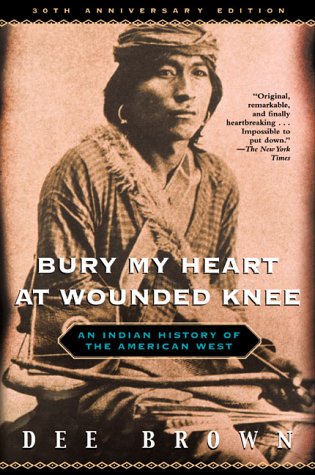
Bury My Heart at Wounded Knee


I know this is a mini-series documentary now, but this book by Dee Brown is very powerful in its own right. It took me a long time to finish less because it's a long book, but more because I could only read so much about irrational, unfounded savagery on the part of our nation's white imperialists from the past at any given time. I'd say that this would definitely round out any curriculum on the settling of the West (obviously at a high school or higher level - just because I don't think a class of elementary school kids could make it through the book).

Hugely worthwhile for all Americans able to read the book. The prose is not light (by any stretch of the imagination), but is very readable & isn't difficult to read in a technical sense. Highly, highly recommended.

Saturday, October 01, 2005

Slaves in the Family

This book by Edward Ball took me a week or so to read. Though some parts are a little dry, the subject matter is very compelling. Growing up, Ball knew his family had at one time owned slaves, but the family did not encourage conversation on this topic. Needing to know more, he began researching and trying to find the descendants of the slaves his family had owned. Not all greeted him with open arms and some of his own family members were hostile. Through the process he found several people who are very likely related to him. The book discusses slavery on the rice plantations of South Carolina and larger issues of the slave trade, changing political climates, etc..., but the focus is on this man's family and the families they owned. The family stories he tells and the way he connects families through history - his own and those of others -draws the reader through a dark period of American history that still evokes strong emotions today.

Recommended - I am not aware of any other book quite like this. And for a fairly thorough portrait of what slaveholders and slaves thought about their lives, this provides a pretty good perspective that acknowledges bias, but tries very hard to overcome that bias. Does not turn a blind eye to outrages committed by whites (his own family included), but the message is one of family and of hope.